Hire the person that says – “I Don’t Know”

Teach thy tongue to say I do not know and thou shalt progress! 

– Moses ben Maimon (Maimonides)
Hiring

Over the years, I have interviewed and hired (& sometimes fired) many people – including engineers, product managers, QA, marketers, project managers, senior leaders, etc. Whether it’s a startup or a multinational corporate, hiring is arguably one of the most important decisions for the company.

So, how to hire the right people for the job? How to separate wheat from the chaff? Here are a few things I look for when I interview & hire people:

Domain Knowledge: Whether you are running a refrigerated meat warehouse or building a Cassandra big data warehouse, unless you are hiring fresh grads, you need to hire people who have an understanding of your business, technology involved, industry knowledge, etc. Hiring people with the right domain knowledge mix allows you to build the correct product/service with fewer mistakes & iterations. There is a reason why companies like Apple, Google, Facebook, Netflix, Yahoo, Microsoft, Tesla, etc. pay premium salaries & sign-on bonuses while poaching from each other to get the domain expertise.

Basic Smarts: Don’t think I need to elaborate much on this.

Tenacity & Persistence: Great products/services don’t built in the first iteration – similarly tough problems don’t get solved in the first try. You need to keep going at it until you crack it. I look for evidence in the person’s resume/background that shows that the person has the persistence to keep going even when things get tough.

Details & Execution Strength: As they say, success is 1% inspiration and 99% perspiration. I like people who are willing to sweat the details and focus on execution (aka get stuff done) – I’m not a big fan of people who skim the details. If you don’t dive into details, whatever you deliver will be pedestrian quality that will crumble sooner or later. When Mark Hurd got fired from HP, he immediately got hired by Oracle with a $40 million pay package. Why? Mark had a reputation for detailed analysis and focus on driving results. Read more about my views on attention to details…

Thinking Patterns: I like to understand how the candidate structures his/her thinking on a given topic. To judge this, I sometimes ask candidates to share a non-confidential document/deck that they have authored. This also helps me gauge their communication skills.

Team Composition & Culture: You need to ask the question – how does this new person fit into the overall team composition? People-person vs lone-wolf, tactical do’er vs strategic thinker, leader vs follower, specialist vs generalist, academic vs hustler, etc. End of the day, what you want is a well-balanced and a well-rounded team that gets the job done.

… and now about that rare quality:

I Don’t Know: Professional and Intellectual honesty is one of the most under-rated qualities – it’s also a quality that’s hard-to-detect. Everything else being equal, when I find a smart candidate that says “I don’t know” for a question or a concept, I know I have found an intellectually honest candidate. This also affirms that the candidate is not a glib talker.

Hiring right is more of an art than science – hope you find the Yoda you’re looking for!

Driving Big Impact with Little Details

Little things make big things happen!

– John Wooden

Attention to Detail

Ever wondered what sets apart a 3-star Hilton from a 4-star Hyatt? A 4-star Hyatt from a 5-star Ritz Carlton? End of the day, they are all hotels with similar amenities – beds, bathroom, linen, TV, writing desk, swimming pool, front desk etc. So what gives?

Attention to Little Details!

Among other things, the biggest differences within different levels of hotels are the little details that translate to a more refined customer experience. As you go up the star chain, the attention to detail gets better – the guy behind the desk is better dressed and more helpful, the bed sheet thread count goes up, pillow menu – multiple pillows of varying softness, the room décor & accoutrements are more refined, swimming pool is better maintained, nicer landscaping, parking lots are better paved & lighted, etc.

However, when it comes to the technology world, for a variety of reasons, there is a lot of focus on ROI driven “big bang” features and functionality while refinements and attention to smaller details often take a back seat.

When using products (and driving my teams that build technology products), I tend to pay a lot of attention to little details. Here are a few that I love:

  • Palm Treo (RIP): The Palm platform had its own share of rabid followers until iOS/Android ate its lunch (and dinner). On the Palm Treo when you received a call, there was a little button on the lock screen that let you send a text message “Call you back in 10 mins” with one click of the button. That’s a clever little detail that I always wanted on the iPhone – Apple added this last year in iOS 8.
  • Microsoft Outlook’s Insert Screenshot: A lot of people in corporate world would rather give up their first born than give up Microsoft Outlook on Windows (I am probably in that camp). When writing emails, you often need to add a screenshot to illustrate your point. Outlook’s email compose window has the “Insert > Screenshot” menu to quickly add a screenshot. This is one of those little gems that saves the tedium of “capture screenshot > save image to desktop > attach image to email > delete image file on desktop”.
  • Apple Magic Mouse 2 “Sound”: One can’t talk about attention to detail without an obligatory mention of Apple! Recently Apple released the Magic Mouse 2. With all the changes they made, apparently the mouse didn’t “sound right” when it was moved around on the desk. The engineers had to continuously tweak the bottom polycarbonate runner geometry until the mouse “sounded right”. Read more here…
  • BMW 328i: Cars have 5 to 6 buttons on the dashboard to program your favorite radio station. BMW takes those 6 buttons to the next level with 2 refinements: (1) Those 6 buttons are touch-sensitive – if you lightly touch (not press) any of those buttons, the dashboard display shows the radio station (or action) assigned to that button. (2) You can assign different actions to those 6 buttons – not just radio stations. I programmed the 6th button in my wife’s car to the navigation system’s “Go Home” functionality. When driving in unfamiliar neighborhoods, to head home, all my wife has to do is press the button 6 and the navigation system fires up to head home. This really saves her the distraction of futzing around the multi-level menus when driving. Clever!
  • Google Express: Yesterday I ordered a few items on Google Shopping Express. When they were delivered in the evening around 7:45pm, there was a problem with one item in the batch – the lid for a liquid soap bottle was broken. At 8pm somebody from Google Express called to discuss the issue. Usually delivery services expect the customer to contact the company when there is a problem. In this case, Google Express proactively called me to discuss the issue. To make that happen, Google had to setup a process where the delivery driver notifies the back office about a problem & the backoffice calls the customer immediately (at 8pm) – providing that level of service requires a non-trivial investment of time and resources. Kudos to Google!

So, organizationally (not at an individual level), how to drive attention to detail?

4 things come to my mind:

  1. Resources: You have the ask the tough question – do my teams have the people and resources to deliver attention to detail? Quite often, teams are spread thin – too few people doing too many things – structurally that does not lend itself attention to detail. In order to deliver attention to detail, you need to make sure that people aren’t spread too thin.
  2. Hiring Right: Hire the people with the right background, culture and mindset. Hiring a chef from Taco Bell for a job at Ritz Carlton doesn’t work!
  3. Balanced Roadmaps: As a part of product roadmaps, mandate your team to include refinements that improve user experience with little details. More on that here…
  4. Set the Bar: An expectation & bar needs to be set with regards to attention to detail – AND hold people accountable to that bar. For example – if your product/service doesn’t meet the expected bar, delay the launch. That puts the pressure on the teams to keep working until the bar is met.

Summary

Whether its products or services, B2B or B2C, in addition to ROI driven activities, features and capabilities, teams need to invest time & resources to pay close attention to detail. That is how products/services build a strong fan base that resist abandoning your product/service when a competitive product/service with a cheaper price comes along.

No wonder successful companies like Apple, Lexus, Ritz Carlton, Microsoft, etc. consider “attention to detail” a big part of their strategy to deliver great products/services!

Sharpening Axes & Chopping Trees – User Research & Building Products

Give me six hours to chop down a tree and I will spend the first four sharpening the axe. 

– Abraham Lincoln

Why do certain companies like Apple, Netflix, Google, etc. offer compelling product experiences (i.e. software features & functionality, user experience, etc.) while other companies just put out mediocrity? Most technology companies employ similar set of product teams comprised of engineers, QA, product managers, visual designers, etc. So what gives?

Everything else being equal, it’s the investments these companies are willing to make in User Research (not UX, graphic artists or Visual Design, but pure user research)!

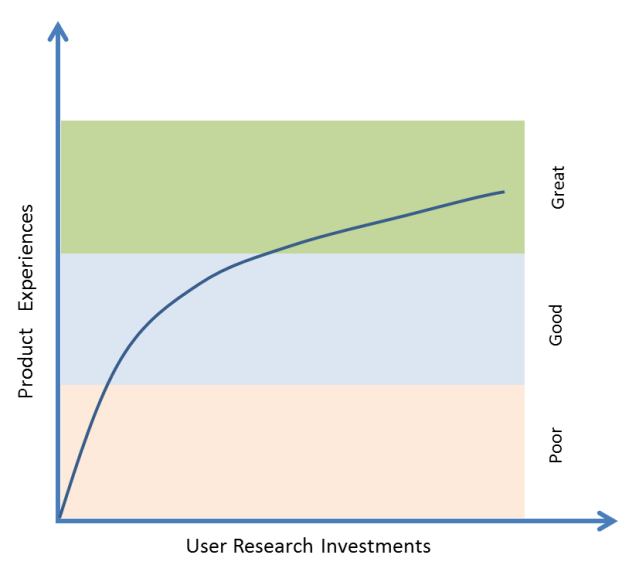
Here is a figure that illustrates my observations and experience.

UR Investments

Engineers, product managers, product marketing and visual designers can only do so much with brainstorming, competitive research, market research, reading tea leaves in analytics data, etc. to drive good product experiences. To really elevate good product experiences to great product experiences, what’s needed is a healthy amount of user research.

Examples?

  • Activity & Fitness tracking in Apple Watch: It’s a common notion to attribute Apple’s success to their stellar marketing. While it’s true that Apple’s marketing is second to none, it’s the product experiences that are central to Apple’s success – marketing just provides lubrication & acceleration for that success. To come up with compelling product experiences, Apple spends massive amounts of time and effort researching users, lifestyles, use case scenarios, etc. and that insight is used to drive the product’s functionalities. To drive the fitness and activity tracking functionality in Apple Watch, Apple invested in a 23,000 sq ft fitness lab and spent 2 years collecting 18,000 hours worth of workout data based on 10,000 sessions. The functionality that you see in Apple Watch today is based on those insights. Regardless of whether Apple Watch succeeds or bombs, its impressive to see Apple put in that kind of effort for just the activity & fitness tracking aspect of their product. More details and a video on this…
  • Moto X Active Display: If you are a Android handset maker, how do you differentiate yourself from other Android handsets that are all powered by Google’s Android? Motorola’s Moto X has a clever feature called Active Display that allows you to see the clock and notifications without turning ON the phone. This power saving Active Display capability came out of user research & observation that people turn ON their phones 40-50 times a day (and drain battery) just to see the clock and notifications. See Punit Soni (ex-VP at Motorola) talk about the user research that led to this innovation…
  • Netflix new redesign: We are all guilty of occasional indulgence in binge watching Breaking Bad, Game of Thrones, House of Cards, etc. In June 2015 we can do more of that when Netflix launches its major redesign in 4 years. This redesign was based on insights obtained by a dozen researchers conducting 1500 interviews in people’s homes to understand how they use Netflix. Netflix also sent out 15 million surveys to get an understanding on what it takes to get people to watch shows. All this user research takes a large amount of effort to eke out further improvements in an area where Netflix already has a monopoly. More details on this…

What happens to products developed without User Research? Products developed without the insights & context of User Research tend to become engineering and feature driven rather than user need driven!

That brings us to the point about axes and trees…

Before chopping a tree, spending hours to sharpen an axe is all about preparation. Similarly, to prepare for & to create compelling product experiences, companies (especially software companies) need to invest more in user research and use that insight to drive the functionalities & user experiences that make (or break) products!

So, how well does your company invest in User Research?

Timing Life Events with Economic Cycles

Life is all about timing!

– Carl Lewis

StopWatch

In business or personal life, the timing of certain actions/decisions have long lasting impact – maybe even a lifelong impact.

A few examples:

  • Kids graduating college in recession (as opposed to a flush economy) have to settle for 10%-15% reduction in earnings when they start their careers and they can take upto a decade to recover from that. For some kids, the impact may be life long – they may have started their careers in a less-then-desired industry (as a compromise in a down economy) and never ended up moving to the desired industry for which they studied. This topic has been well researched. Read more on this…
  • Most of my friends bought their houses in Bay Area prior to 2008. When the housing market cratered with the sub-prime crisis in 2009 and the interest rates went really really low, many of us were lucky enough to refinance our houses at record low rates. However, some of my friends couldn’t do the same because their house values were “under-water” – our quirky mortgage financing system didn’t allow these people to refinance. Turns out that there were millions of people in that boat. All those people who held onto their houses and paid mortgages month after month – they were practically flushing cash down the proverbial toilet because they were paying mortgage at inflated interest rates. If these people had bought their houses a little earlier or a little later, they could have refinanced their mortgages!
  • If you are an entrepreneur, here is one for you. Airbnb is a well known unicorn decacorn startup that upended the hotel industry by allowing people like you and me turn that extra bedroom into a cash cow. One of the main reasons for its success is attributed to the timing of when it was launched – Aug 2008, right around the subprime crisis. When the subprime recession hit the world, people needed that extra money and they eagerly jumped onto the Airbnb bandwagon jump-starting its success! Read more on this…

If timing is so important in life, how are we supposed to time such events – especially the big personal life events?

Even though you may not be able to time all events in life (e.g. timing of college graduation), I propose that some major life events can certainly be timed to your advantage. You can do that by using the broad stock market as tool for timing. While this is not easy, it is not impossible – you just need some fiscal discipline and a strong stomach! Here is the recipe…

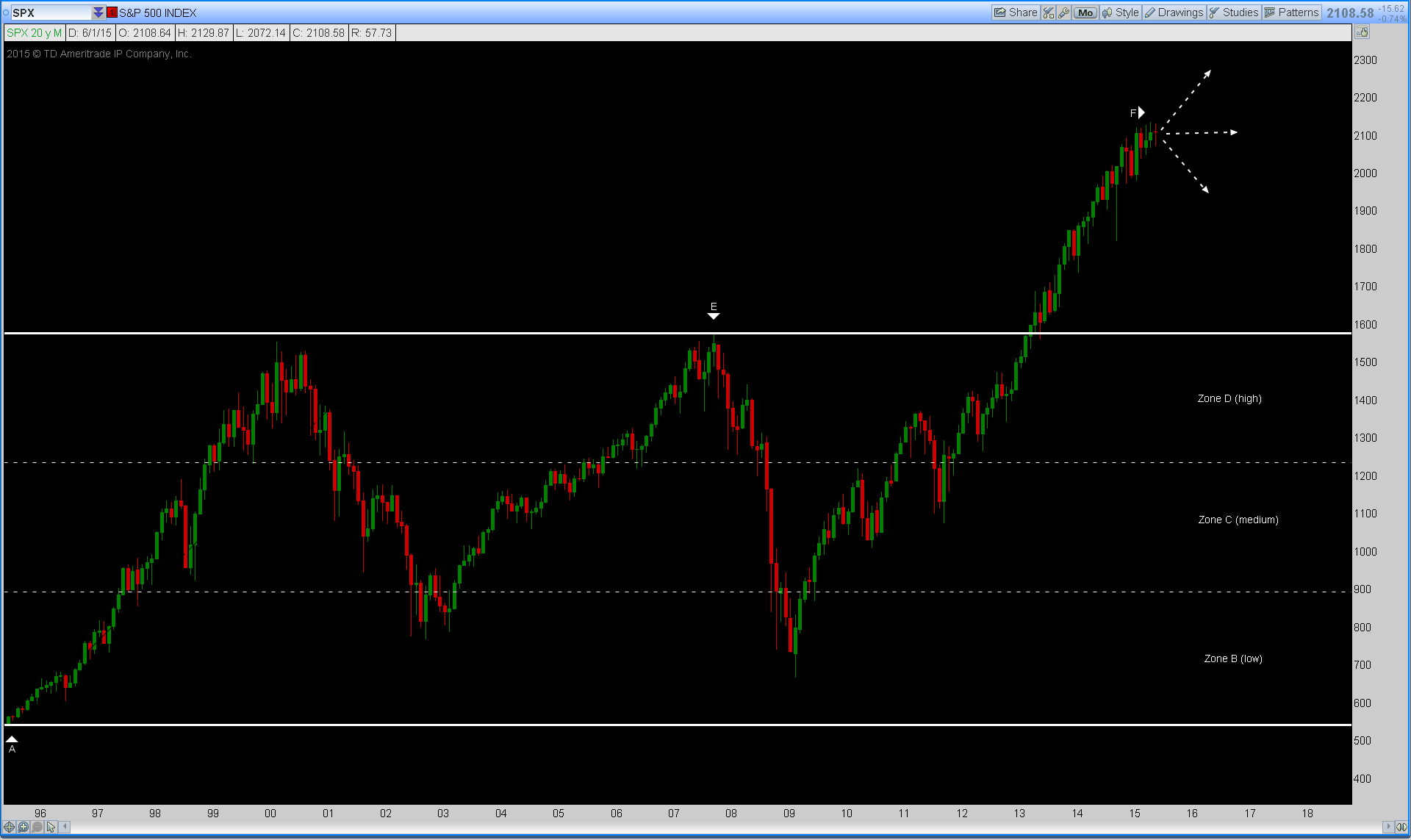
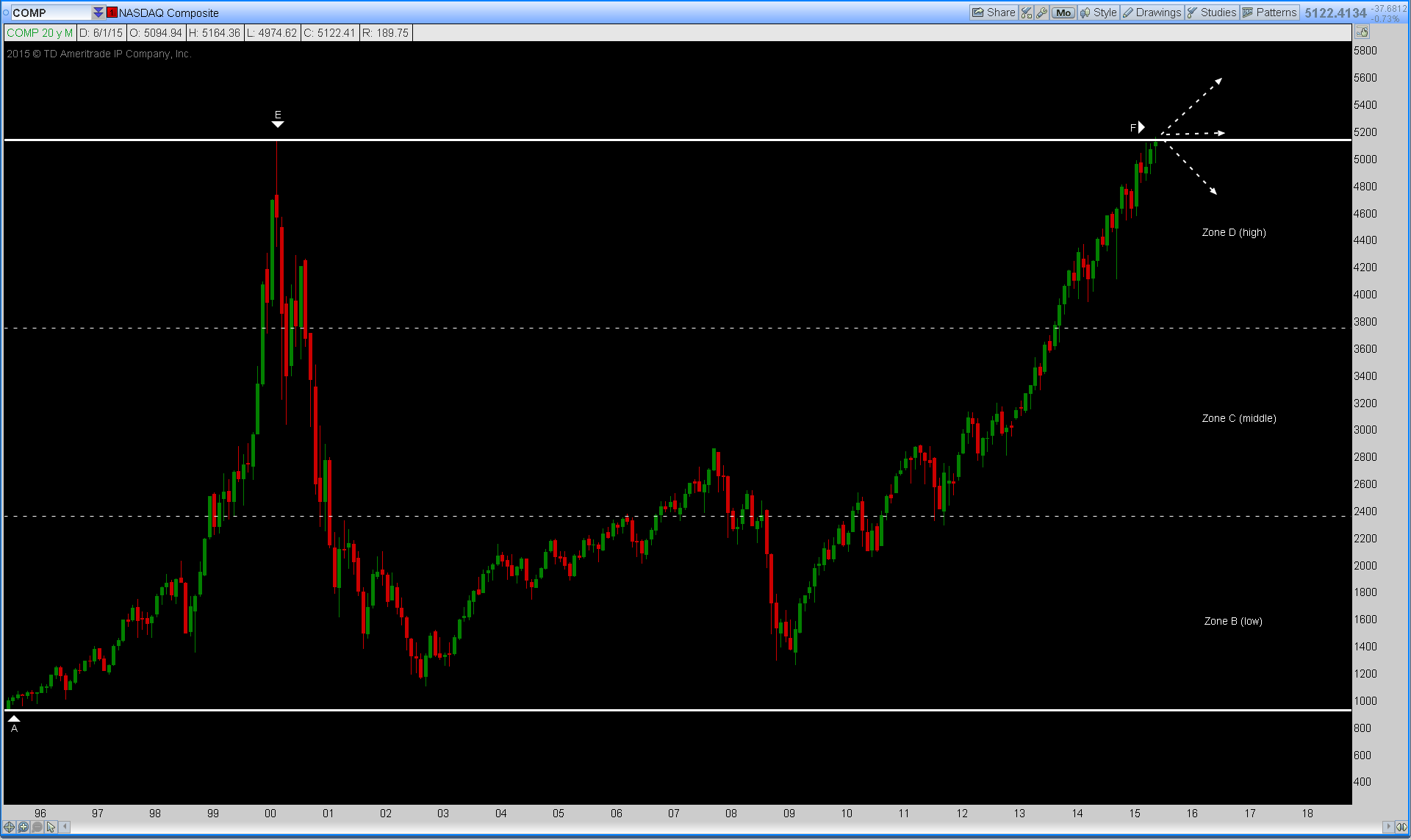
See below the 20 year stock charts (click to magnify) of S&P 500 and NASDAQ Composite – these 2 indexes basically capture the essence of the US boom-bust economic cycles.

SPX

COMP

In the both charts, I took the prior low (point A) & high (point E) and divided that area into 3 equal zones B/C/D – the lower third, middle third and upper third. Point F is where we are today – at all time highs. I know what you are thinking – from here on, are we going to go up (and for how long), go sideways or go lower? When is the market going to crash?

While those are valid questions, the point of this blog post is NOT about timing the stock market for profit. History tells us that this party is eventually going to end. When and how – I don’t know. Far too many super-smart people on the Wall Street don’t get that right so I am not even going to attempt that.

Instead, what I am presenting here is a broad framework that lets you align major life events with the boom-bust economic cycles. Given that we are currently at the highs of the economic cycle (i.e. zone D and beyond), you could think about the major life events that you have coming up in the next 2-5 years and position yourself accordingly. Some ideas:

  • If you are retiring in the next 2-5 years, a conservative plan would be to move your investments (e.g. stocks, 401k) into safer investments like CDs or bonds.
  • If your kids are going to enter college in the next 2-5 years and their college fund in invested in any investment that can be affected by the stock market, now might be the time to move that college fund into safer options.
  • If you have a startup and you are getting an attractive acquisition offer, depending on factors like cash flow, need for additional funding etc., its not a bad idea to consider an exit now.
  • If you live in an expensive real estate market and you plan to sell the house in the next 2-5 years (because you are retiring, downsizing, etc.), now is a good time to sell that house while the stock and real estate market is at record highs. Yes, by selling now you forego any future profits. The name of the game here is to conservatively protect your profits (given your 2-5 year time frame) and NOT about aggressively maximizing your profits trying to identify the absolute top.
  • If you are looking to buy a house, now is definitely not the best time – you could wait until the stock market returns to Zone B (or at least Zone C). Remember – once the market starts going down, it goes down very fast. The dot com excess in 2000 got cleaned up in 2.5 years and the subprime crisis excess in 2007 got cleaned up in about 1.5 years. If waiting for Zone B saves you 20%, that’s an easy $150k – $200k savings (or more) in the Bay Area housing market – that’s nothing to sneeze at!

The underlying principle here is very simple – aligning some of your big life decisions to lower third (zone B) and upper third (zone D) of the broad stock market increases the odds in your favor (but no guarantees)!

Also remember, this framework is NOT about maximizing the profits by riding the party bus to the absolute top – instead it’s about conservatively aligning the life events with broad economic cycles so that you are protected by increasing the odds in your favor!