Index & Chill: Investment Approach for Gen Z

Image created on Microsoft Bing Copilot Image Creator. Prompt = black and white coal minimalist sketch, psychedelic style, illustrating investment growth, use the $ sign subtly, background has images of young woman and man evolving into adults

Papa, how do I invest my earnings and savings?

That’s the sweet sound of a young coming-of-age Zoomer taking flight in life – a milestone that every parent looks forward to! This summer my first-born graduated and started work. As her paychecks rolled in, she was looking for options to save and invest. I figured, it’s best to write an informational blog post on this topic and let her make the decision. So here it goes… investment options for a Zoomer to grow their money for the long term.

Investment Options: Today, Zoomers face a bewildering array of choices to deploy their savings. Here are 10 common investment choices – with the lowest risk/reward option on the top and the riskier yolo options at the bottom:

  1. High Yield Savings Account: To combat post-covid inflation, US Federal Reserve has hiked interest rates 11 times starting March-2022. As a result, banks are now offering a healthy 4%+ interest rates on their high yield savings accounts. Zoomers with their iPhones can quickly open an online Apple Savings Account and get about 4.1% return – see how Apple Savings stacks up against other similar competetitors.
  2. CDs (certificate of deposit): Similar to HY savings accounts, CDs are available in the realm of 4.25% for 4-months or 3.75% for 11-months. Unlike HY savings accounts, your funds invested in a CD are locked up for that term period. It’s interesting to note that we are in an unusual inverted yield curve era where the return for the short term maturity is higher than the ones with a longer term maturity.
  3. Bonds: Bonds are fixed interest investment option where you lend your money to municipalities, corporates or government. The return depends on who you are lending it to, their credit worthiness and the term of the bond. Some municipal bonds can also be tax free.
  4. Real Estate: Once you have some capital built up, you have the ability to buy a condo/house, become a landlord and collect rent. Your rate of return is a combination of rent collected plus the property appreciation over the years. Residential real estate return is in the ballpark of 6%-8% – but you have to spend a non-trivial amount of time being a landlord (e.g. finding renters, broken plumbing, bum renters not paying on time). If real-estate is your thing, here’s a good article to read on buying real-estate vs a REIT.
  5. Index funds: You can invest in a broad market index fund like SPY (S&P 500), tech heavy index QQQ (NASDAQ 100) or other such options. SPY’s 10-year annualized returns are ~13% while QQQ’s 10-year annualized returns are ~18%.
  6. Mutual Funds: There are thousands of mutual funds out there – small/mid/large cap, US/international, different sectors, risk profiles, etc. – MorningStar is a good resource to research mutual funds. The risk/return depends on the nature of the fund you pick. The one thing to keep in mind is – about 65%-80% of them underperform S&P 500 benchmark index.
  7. Cherry Picking Stocks: US has 2 major stocks exchanges (NYSE & NASDAQ) plus a few other smaller ones. Across these exchanges, there are thousands of stocks available to pick and choose. Cherry picking stocks in the hope of landing a 10-bagger Magnificent 7 seems to be the favorite pastime of most middle-aged men. 
  8. Active Trading: Cherry picking and investing in stocks for the long-term over months/years is one thing. However, one can more actively trade stocks, options, futures, forex, commodities, leveraged ETFs, etc. This is a more active/leveraged form of #7.
  9. Alternative/Exotic Investments: US being a capitalistic society, depending on your knowledge, net-worth and appetite for risk, you have a range of exotic investment opportunities such as crypto-currencies, hedge/VC funds, art, horses, oil and gas limited partnerships, etc. Heck, if you have the money, you can even buy a banana art for $6.2 million and eat that banana!
  10. Do a Startup: In my view, everyone should do a startup once (i.e. start a startup from scratch, not just working in a startup with a salary). Doing a startup is an extreme form of high-risk high-reward investment – you are investing your own capital, time and sweat equity into a startup with a hope of making it big. This is one of those investments where neither success nor failure is guaranteed, the only guaranteed return is learnings!

Recommended Option: Having done all of the above (except for #9), I would lean towards a combination of “#5 Index Funds” & “#7 Cherry Picking Stocks”. In fact, if I could rewind the clock and advise my younger self, I would do allocate my savings 40% SPY, 40% QQQ and 20% Cherry Picking Stocks. Here is why:

  • 40% SPY & 40% QQQ allocations:
    • Good Steady Returns: SPY returns ~13% per annum over long periods of time (years/decades) while QQQ does ~18%.
    • Simple, Diversified, Scalable: Buying SPY/QQQ takes a few seconds, no additional baby-sitting needed to manage your portfolio. When you buy SPY, you get automatic exposure to S&P 500 – a set of 500 companies that represent the broad market across all 11 sectors (tech, finance, consumer discretionary, healthcare, industrials, real estate, materials, energy,  staples, communications). On the other hand, QQQ is tech heavy. Whether it’s hundreds of dollars or hundreds of thousands of dollars late in your career, the approach remains the same – buy them with a click of a button and watch the portfolio grow over years. The key is to stay the course and dollar cost average during rough years (e.g. 2022, 2008, 2000).
    • Automatic Rebalancing & Exposure: Both SPY and QQQ are rebalanced quarterly – i.e. dud companies are removed, hot companies are added. Which means, your investment in SPY/QQQ is also automatically pruned/rebalanced without you having to do anything. For example, if and when OpenAI goes public, they will likely get added to the QQQ index and you will automatically get exposure to OpenAI.
    • Automatic Tailwind: Hundreds of Billions of dollars are invested in an index fund like SPY and QQQ – think of all those 401Ks and pension funds funneling their flows into SPY & QQQ. This constant flow of money into SPY and QQQ provides a tailwind for SPY and QQQ to perform well over the long term.
    • Low Expense Ratio: Because SPY and QQQ are mirroring the index, they have super low expense ratios.
  • 20% allocated to Cherry Picking: The act of cherry picking stocks with your hard earned money gives you an opportunity to learn about economy, business, details about the companies you pick, fundamental/technical approaches to investing etc. Your picks will most-certainly lag the performance of SPY/QQQ, but you will learn a lot in that process. Think of the losses/underperformance as the price of education!

For somebody starting off in life, I can’t think of any other asset class where the benefits of automatic tailwind (of retirement investment flow) + automatic rebalancing ensures that your investments can only grow over long periods. The downside – no bragging rights that you get with cherry picking, does not make an interesting cocktail conversation, boring as watching grass grow on a sloth!

If one were to follow this strategy, what would be the end result? Assuming a $12k annual investment (i.e. $1000 per month) for a typical career length of 30 years, depending how one allocates the portfolio across SPY & QQQ, the end result will likely land somewhere between $3.5 million and $9.5 million (see the below spreadsheet) – not bad for a simple/boring strategy! So what did my first-born choose? Let’s just say she didn’t disappoint (at least for now), I’m looking forward to seeing how her approach evolves over the coming years😊


Passions, People & Products

Passion is the genesis of genius

– Tony Robbins


Passion


Show me a great product (or service) and I will show you the passionate people behind that endeavour!

So what exactly is passion? Quite simply, passion is that invisible energy that drives people to go beyond what an average Joe can do. Among its many dimensions, here are the 5 most important:

  • Ownership: Passionate people don’t wait to be given formal ownership and responsibility – they assume responsibility and work towards doing the right thing. If something that needs to get done is not getting done, they are the first ones to roll up the sleeves and get it done – no matter how unpopular or unpleasant that task is! Passionate people are informally seen as the “go to” people in an organization even if they don’t have a suitable title.


  • Motivation & Drive: Passionate people don’t need to be told what they need to do and how they need to do it. They are self-driven and they drive themselves (and others) to do whatever it takes to get the job done. These are usually the people that don’t suffer from monday morning blues!


  • Second level thinking: First level thinking is the simplistic and superficial thinking/analysis where you are looking at the obvious – one is barely scratching the surface. Second/higher level thinking is when you are start peeling the onion layers – you evaluate the range of possible outcomes, probabilities and start considering countermeasures as needed. Passionate people think and see beyond the obvious – always 2 steps beyond/deeper what most people can think or see. Attention to detail is one of the manifestations of higher level thinking – more on that topic here

    You can read more about second level thinking here, here and here.


  • Persistence & Grit: In corporate there are plenty of obstacles – budgets, timelines, conflicting priorities, group fiefdoms & politics, incompetencies etc. Most people get caught up in the obstacle waterloo and cannot go beyond. Passionate people are usually able to power through these hurdles and accomplish what they set out for – all they see is the goal and not the obstacles in their way. In the early days of Tesla, Elon Musk had to fund Tesla with his personal finances and he was close to being bankrupt – he just kept going!


  • Pride: Passionate people see their work as a reflection of themselves and their capabilities and they will go to extreme lengths to make sure that what they put out is something that they can be proud of. 

    I have a designer JS on my team who was about to have his second child around the same time we were making some crucial choices on our product’s redesign – color palette and other visual design directions. Rather than leave these crucial decisions to his temporary replacement, JS took his laptop to the hospital and was cranking out designs from the delivery room (probably to his wife’s chagrin)! Our product was also his baby and he just couldn’t let somebody else dictate his baby’s visual design – that’s pride!!


Want to see what passion looks like? See Elon Musk (founder of Tesla & SpaceX) in this 2 min video – he actually cries listening to the critique from the very people he admires & worships!

Being passionate is one step short of being crazy – and people like Elon Musk, Jeff Bezos, Travis Kalanick & Steve Jobs personify that!


शेर गज़ल नज़्म & Jagjit Singh


jagjit


Preamble

5 years to this day, India’s best ghazal singer Jagjit Singh passed away. For me, there’s no discussion of sher-o-shaayari without invoking the memory of Jagjit Singh.

It was early 1980’s when I was in 8th or 9th grade. Living in Hyderabad/India, I would amble about the house while my father would listen to ghazal or qawwali. My next door neighbor Mr. Azam would wax eloquent about the finer points of Mehdi Hassan’s ghazals. At the cavalier age of 12 or 13, I couldn’t care less about ghazal-wazal!

Fast forward to 1987-88, I was in my first or second year of engineering college. I stumbled upon a cassette of Jagjit Singh’s album The Unforgettables from my father’s music collection. I was awestruck by Jagjit’s voice and that sparked my curiosity of Urdu poetry. By the time I finished my engineering in another couple of years, I had bought almost every album that Jagjit Singh released and most of his songs and their lyrics were etched into my brain for eternity.

Over the years I have heard most of the stalwarts – Mehdi Hassan, Ghulam Ali, Pankaj Udhas, Farida Khanum, Nusrat Fateh Ali Khan, Abida Parveen, etc. But, I kept coming back to Jagjit Singh. The reason was very simple – he always rendered the ghazal in a simple mellifluous melody. Even though Jagjit Singh was an accomplished Hindustani classical singer, he rarely engaged in any vocal ustadi (i.e. vocal virtuoso techniques like taankari) because he believed that vocal acrobatics distracted the listener from the ghazal lyrics. Jagjit Singh truly personified the bol-pradhan style of singing – he let himself be the invisible vocal medium while letting the lyrics of the shaayari take the spotlight. His choice of what to sing was also very deliberate – he chose easier to understand ghazals by poets like Qateel Shifai rather than the loftier ones penned by Ghalib.

So, what exactly is shaayari?


Shaayari – Sher, Nazm, Ghazal & Ruba’i

Quite simply, shaayari is poetry in Urdu language, while the poet is a shaayar. Here are some common forms of shaayari that have their own form and style:


Sher: It’s a two line couplet, a poem. A sher can be an independent poem or part of a larger ghazal. Think of a sher as a single lustrous pearl.


Nazm: A nazm is a freestyle form of urdu poetry with a lot less restrictions around the structure and rhyming pattern. A nazm can be 2 lines or a multi-line paragraph. The focus of the nazm is around the content and thought without much rigidity of the constraints. Given this freedom, writing a nazm is a lot less difficult that writing a proper ghazal.


Ruba’i: It’s a form of nazm that’s a 4 line poem. A collection of such quatrains is rubaiyat. The beauty of a ruba’i comes from its rhyming pattern where the first, second and the fourth lines share a rhyme while the third line breaks the monotony of the rhyme in the other 3 lines.


Ghazal: A ghazal is a string of shers (usually 5 or more) linked to a central theme. If a sher is a single lustrous pearl, think of the ghazal as a beautiful pearl bracelet with 5 or more sher. A ghazal is very structured with strict rules to follow – hence not very easy to write. Here are the 5 basic constructs of a ghazal:

  • Matla: The first sher of the ghazal. The two lines of a matla must end with radeef.
  • Radeef: It’s the common word(s) at the end of the first two lines of the matla. This radeef must also be used at the end of the second line of other shers in the ghazal.
  • Kaafiya: It’s the rhyming word that comes before the radeef. In a ghazal, all the kaafiya share the same rhyming sound.
  • Beher: It’s the meter of the ghazal – the length and the tuning pattern. A ghazal that doesn’t use a proper beher cannot be composed or sung musically. Writing a ghazal with proper beher that can be sung in rhytm, requires choosing words of appropriate length & rhyme while respecting the rules of a ghazal construct – a very difficult proposition. It’s not unusual for musicians & composers to occasionally make slight changes (the gustaqi) to lyrics (without changing the meaning) so that the lyrics fit the rhythm of the song.
  • Maqta: The last sher of the ghazal. It’s customary for a poet to use his takhallus (pen-name) in the maqta.


Here is a famous ghazal by the poet Mirza Ghalib:


दिल-ए-नादान तुझे हुआ क्या है

आख़िर इस दर्द की दवा क्या है


हमको उनसे वफ़ा की है उम्मीद

जो नहीं जानते वफ़ा क्या है


हम हैं मुश्ताक़ और वो बेज़ार

या इलाही, यह माजरा क्या है


जान तुम पर निसार करता हूँ

मैं नहीं जानता दुआ क्या है


मैने माना की कुच्छ नही ग़ालिब

मुफ़्त हाथ आए, तो बुरा क्या है


In this classic ghazal, क्या है is the radeef while the rhyming words वफ़ा दवा बुरा दुआ are kaafiya. In the maqta (last sher), the poet uses his taqallus Ghalib!


These are just the basic constructs and there are many more rules around writing a proper ghazal. With all these constructs and constraints, as you can imagine, writing a proper ghazal requires a firm grip on vocabulary, poetic aesthetic and even a musical sense.

Traditionally ghazals are written around love, longing, rejection, etc. But, at times, ghazals have a spiritual interpretation where the beloved is a metaphor for God. This duality in interpretation makes the ghazal even more sublime!


Homage

In the last 25+ years, for me, not a week has gone by without listening to Jagjit Singh. He invisibly accompanied me on walks, hikes, drives, on beaches, on buses trains and planes. With his music on my phone, he went everywhere I went – a constant companion. Over 25+ years I developed a je ne sais quoi relationship with Jagjit Singh – depending on what he was singing,  he was a a friend, a philosopher or a father figure!

I can think of no other way to pay homage to Jagjit Singh other than writing a ruba’i in his honor:


ना है तू यार

ना है क़ुरबतदार

फिर तेरे जाने पे

क्यों है हम ज़ार-ज़ार


I remember this as if it happened yesterday. On that crisp October morning 5 years ago, I dropped my kids off to school and went for a morning walk in the neighboring Ortega Park. While walking, I read on Facebook that Jagjit Singh had died. I lost somebody who was no friend or relation – but a constant companion over the decades. Slumped on a park bench, I wept like a baby!


Timing Life Events with Economic Cycles

Life is all about timing!

– Carl Lewis

StopWatch

In business or personal life, the timing of certain actions/decisions have long lasting impact – maybe even a lifelong impact.

A few examples:

  • Kids graduating college in recession (as opposed to a flush economy) have to settle for 10%-15% reduction in earnings when they start their careers and they can take upto a decade to recover from that. For some kids, the impact may be life long – they may have started their careers in a less-then-desired industry (as a compromise in a down economy) and never ended up moving to the desired industry for which they studied. This topic has been well researched. Read more on this…
  • Most of my friends bought their houses in Bay Area prior to 2008. When the housing market cratered with the sub-prime crisis in 2009 and the interest rates went really really low, many of us were lucky enough to refinance our houses at record low rates. However, some of my friends couldn’t do the same because their house values were “under-water” – our quirky mortgage financing system didn’t allow these people to refinance. Turns out that there were millions of people in that boat. All those people who held onto their houses and paid mortgages month after month – they were practically flushing cash down the proverbial toilet because they were paying mortgage at inflated interest rates. If these people had bought their houses a little earlier or a little later, they could have refinanced their mortgages!
  • If you are an entrepreneur, here is one for you. Airbnb is a well known unicorn decacorn startup that upended the hotel industry by allowing people like you and me turn that extra bedroom into a cash cow. One of the main reasons for its success is attributed to the timing of when it was launched – Aug 2008, right around the subprime crisis. When the subprime recession hit the world, people needed that extra money and they eagerly jumped onto the Airbnb bandwagon jump-starting its success! Read more on this…

If timing is so important in life, how are we supposed to time such events – especially the big personal life events?

Even though you may not be able to time all events in life (e.g. timing of college graduation), I propose that some major life events can certainly be timed to your advantage. You can do that by using the broad stock market as tool for timing. While this is not easy, it is not impossible – you just need some fiscal discipline and a strong stomach! Here is the recipe…

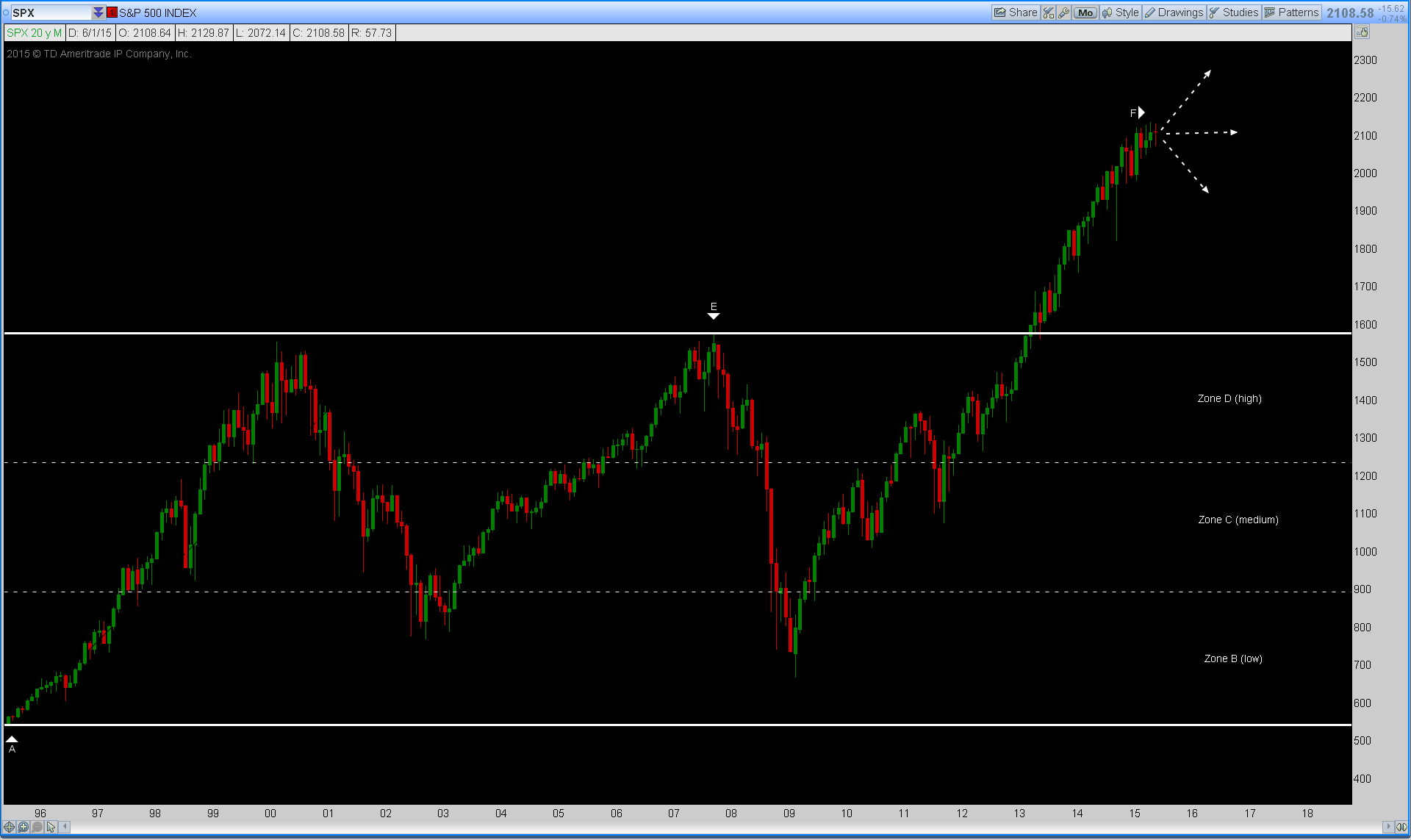
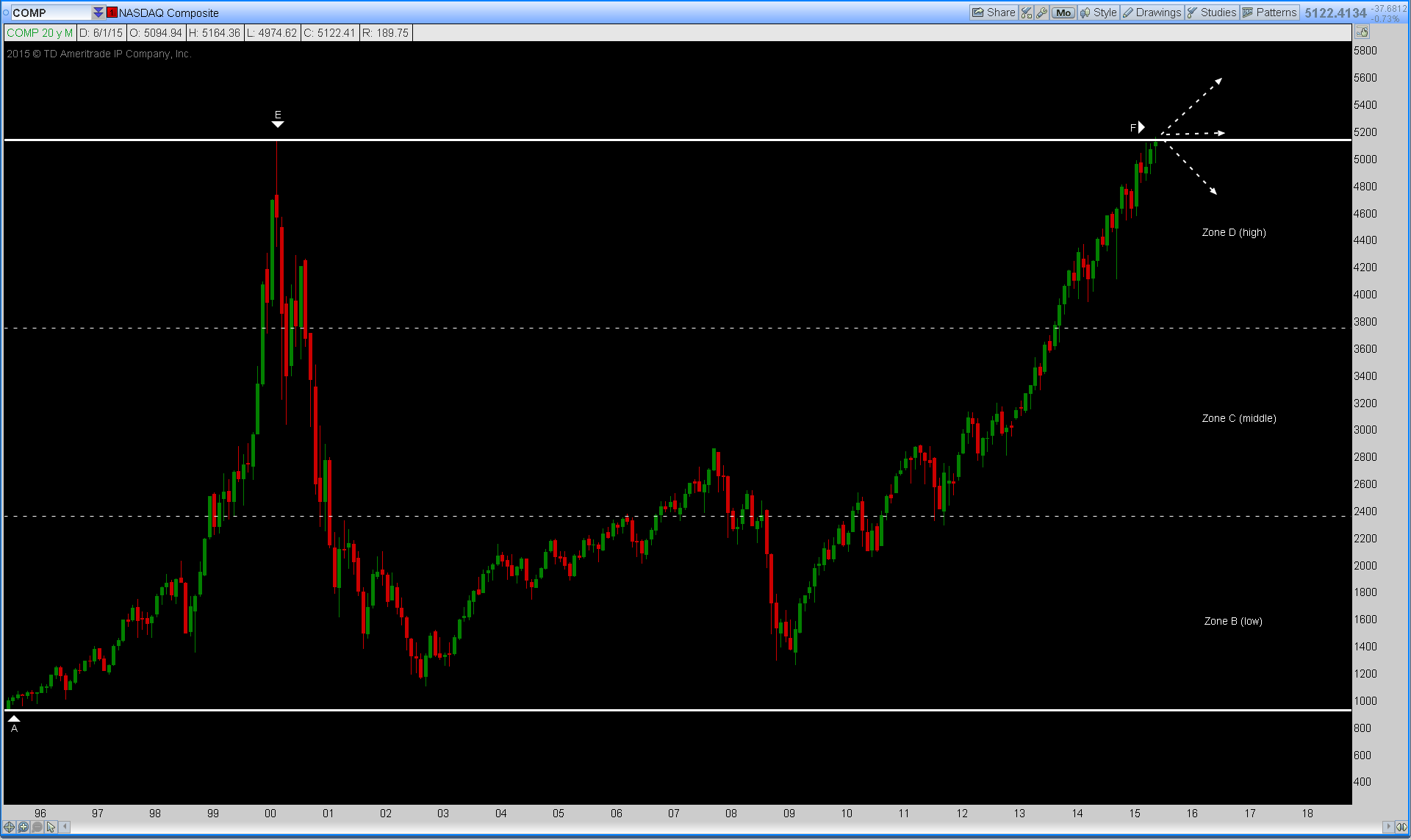
See below the 20 year stock charts (click to magnify) of S&P 500 and NASDAQ Composite – these 2 indexes basically capture the essence of the US boom-bust economic cycles.

SPX

COMP

In the both charts, I took the prior low (point A) & high (point E) and divided that area into 3 equal zones B/C/D – the lower third, middle third and upper third. Point F is where we are today – at all time highs. I know what you are thinking – from here on, are we going to go up (and for how long), go sideways or go lower? When is the market going to crash?

While those are valid questions, the point of this blog post is NOT about timing the stock market for profit. History tells us that this party is eventually going to end. When and how – I don’t know. Far too many super-smart people on the Wall Street don’t get that right so I am not even going to attempt that.

Instead, what I am presenting here is a broad framework that lets you align major life events with the boom-bust economic cycles. Given that we are currently at the highs of the economic cycle (i.e. zone D and beyond), you could think about the major life events that you have coming up in the next 2-5 years and position yourself accordingly. Some ideas:

  • If you are retiring in the next 2-5 years, a conservative plan would be to move your investments (e.g. stocks, 401k) into safer investments like CDs or bonds.
  • If your kids are going to enter college in the next 2-5 years and their college fund in invested in any investment that can be affected by the stock market, now might be the time to move that college fund into safer options.
  • If you have a startup and you are getting an attractive acquisition offer, depending on factors like cash flow, need for additional funding etc., its not a bad idea to consider an exit now.
  • If you live in an expensive real estate market and you plan to sell the house in the next 2-5 years (because you are retiring, downsizing, etc.), now is a good time to sell that house while the stock and real estate market is at record highs. Yes, by selling now you forego any future profits. The name of the game here is to conservatively protect your profits (given your 2-5 year time frame) and NOT about aggressively maximizing your profits trying to identify the absolute top.
  • If you are looking to buy a house, now is definitely not the best time – you could wait until the stock market returns to Zone B (or at least Zone C). Remember – once the market starts going down, it goes down very fast. The dot com excess in 2000 got cleaned up in 2.5 years and the subprime crisis excess in 2007 got cleaned up in about 1.5 years. If waiting for Zone B saves you 20%, that’s an easy $150k – $200k savings (or more) in the Bay Area housing market – that’s nothing to sneeze at!

The underlying principle here is very simple – aligning some of your big life decisions to lower third (zone B) and upper third (zone D) of the broad stock market increases the odds in your favor (but no guarantees)!

Also remember, this framework is NOT about maximizing the profits by riding the party bus to the absolute top – instead it’s about conservatively aligning the life events with broad economic cycles so that you are protected by increasing the odds in your favor!