Index & Chill: Investment Approach for Gen Z

Image created on Microsoft Bing Copilot Image Creator. Prompt = black and white coal minimalist sketch, psychedelic style, illustrating investment growth, use the $ sign subtly, background has images of young woman and man evolving into adults

Papa, how do I invest my earnings and savings?

That’s the sweet sound of a young coming-of-age Zoomer taking flight in life – a milestone that every parent looks forward to! This summer my first-born graduated and started work. As her paychecks rolled in, she was looking for options to save and invest. I figured, it’s best to write an informational blog post on this topic and let her make the decision. So here it goes… investment options for a Zoomer to grow their money for the long term.

Investment Options: Today, Zoomers face a bewildering array of choices to deploy their savings. Here are 10 common investment choices – with the lowest risk/reward option on the top and the riskier yolo options at the bottom:

  1. High Yield Savings Account: To combat post-covid inflation, US Federal Reserve has hiked interest rates 11 times starting March-2022. As a result, banks are now offering a healthy 4%+ interest rates on their high yield savings accounts. Zoomers with their iPhones can quickly open an online Apple Savings Account and get about 4.1% return – see how Apple Savings stacks up against other similar competetitors.
  2. CDs (certificate of deposit): Similar to HY savings accounts, CDs are available in the realm of 4.25% for 4-months or 3.75% for 11-months. Unlike HY savings accounts, your funds invested in a CD are locked up for that term period. It’s interesting to note that we are in an unusual inverted yield curve era where the return for the short term maturity is higher than the ones with a longer term maturity.
  3. Bonds: Bonds are fixed interest investment option where you lend your money to municipalities, corporates or government. The return depends on who you are lending it to, their credit worthiness and the term of the bond. Some municipal bonds can also be tax free.
  4. Real Estate: Once you have some capital built up, you have the ability to buy a condo/house, become a landlord and collect rent. Your rate of return is a combination of rent collected plus the property appreciation over the years. Residential real estate return is in the ballpark of 6%-8% – but you have to spend a non-trivial amount of time being a landlord (e.g. finding renters, broken plumbing, bum renters not paying on time). If real-estate is your thing, here’s a good article to read on buying real-estate vs a REIT.
  5. Index funds: You can invest in a broad market index fund like SPY (S&P 500), tech heavy index QQQ (NASDAQ 100) or other such options. SPY’s 10-year annualized returns are ~13% while QQQ’s 10-year annualized returns are ~18%.
  6. Mutual Funds: There are thousands of mutual funds out there – small/mid/large cap, US/international, different sectors, risk profiles, etc. – MorningStar is a good resource to research mutual funds. The risk/return depends on the nature of the fund you pick. The one thing to keep in mind is – about 65%-80% of them underperform S&P 500 benchmark index.
  7. Cherry Picking Stocks: US has 2 major stocks exchanges (NYSE & NASDAQ) plus a few other smaller ones. Across these exchanges, there are thousands of stocks available to pick and choose. Cherry picking stocks in the hope of landing a 10-bagger Magnificent 7 seems to be the favorite pastime of most middle-aged men. 
  8. Active Trading: Cherry picking and investing in stocks for the long-term over months/years is one thing. However, one can more actively trade stocks, options, futures, forex, commodities, leveraged ETFs, etc. This is a more active/leveraged form of #7.
  9. Alternative/Exotic Investments: US being a capitalistic society, depending on your knowledge, net-worth and appetite for risk, you have a range of exotic investment opportunities such as crypto-currencies, hedge/VC funds, art, horses, oil and gas limited partnerships, etc. Heck, if you have the money, you can even buy a banana art for $6.2 million and eat that banana!
  10. Do a Startup: In my view, everyone should do a startup once (i.e. start a startup from scratch, not just working in a startup with a salary). Doing a startup is an extreme form of high-risk high-reward investment – you are investing your own capital, time and sweat equity into a startup with a hope of making it big. This is one of those investments where neither success nor failure is guaranteed, the only guaranteed return is learnings!

Recommended Option: Having done all of the above (except for #9), I would lean towards a combination of “#5 Index Funds” & “#7 Cherry Picking Stocks”. In fact, if I could rewind the clock and advise my younger self, I would do allocate my savings 40% SPY, 40% QQQ and 20% Cherry Picking Stocks. Here is why:

  • 40% SPY & 40% QQQ allocations:
    • Good Steady Returns: SPY returns ~13% per annum over long periods of time (years/decades) while QQQ does ~18%.
    • Simple, Diversified, Scalable: Buying SPY/QQQ takes a few seconds, no additional baby-sitting needed to manage your portfolio. When you buy SPY, you get automatic exposure to S&P 500 – a set of 500 companies that represent the broad market across all 11 sectors (tech, finance, consumer discretionary, healthcare, industrials, real estate, materials, energy,  staples, communications). On the other hand, QQQ is tech heavy. Whether it’s hundreds of dollars or hundreds of thousands of dollars late in your career, the approach remains the same – buy them with a click of a button and watch the portfolio grow over years. The key is to stay the course and dollar cost average during rough years (e.g. 2022, 2008, 2000).
    • Automatic Rebalancing & Exposure: Both SPY and QQQ are rebalanced quarterly – i.e. dud companies are removed, hot companies are added. Which means, your investment in SPY/QQQ is also automatically pruned/rebalanced without you having to do anything. For example, if and when OpenAI goes public, they will likely get added to the QQQ index and you will automatically get exposure to OpenAI.
    • Automatic Tailwind: Hundreds of Billions of dollars are invested in an index fund like SPY and QQQ – think of all those 401Ks and pension funds funneling their flows into SPY & QQQ. This constant flow of money into SPY and QQQ provides a tailwind for SPY and QQQ to perform well over the long term.
    • Low Expense Ratio: Because SPY and QQQ are mirroring the index, they have super low expense ratios.
  • 20% allocated to Cherry Picking: The act of cherry picking stocks with your hard earned money gives you an opportunity to learn about economy, business, details about the companies you pick, fundamental/technical approaches to investing etc. Your picks will most-certainly lag the performance of SPY/QQQ, but you will learn a lot in that process. Think of the losses/underperformance as the price of education!

For somebody starting off in life, I can’t think of any other asset class where the benefits of automatic tailwind (of retirement investment flow) + automatic rebalancing ensures that your investments can only grow over long periods. The downside – no bragging rights that you get with cherry picking, does not make an interesting cocktail conversation, boring as watching grass grow on a sloth!

If one were to follow this strategy, what would be the end result? Assuming a $12k annual investment (i.e. $1000 per month) for a typical career length of 30 years, depending how one allocates the portfolio across SPY & QQQ, the end result will likely land somewhere between $3.5 million and $9.5 million (see the below spreadsheet) – not bad for a simple/boring strategy! So what did my first-born choose? Let’s just say she didn’t disappoint (at least for now), I’m looking forward to seeing how her approach evolves over the coming years😊

Silicon Valley Engineering VS Wall Street Engineering

I think one problem we’ve had is that people who are smart, creative and innovative as engineers went into financial engineering.

– Walter Isaacson


FinancialEng

What do Citrix & Yahoo have in common? Along those same lines, what do Facebook and Google have in common?

These companies typify the battle that’s brewing between Silicon Valley Technology Engineering & Wall Street Financial Engineering!

Since the early days of Silicon Valley with Shockley Semiconductor, Fairchild Semiconductor and Intel, our tech industry has been intertwined with venture capitalists & wall street. Technology companies need access to cash to fund the engineering efforts. VC’s are only too happy to supply the funds in hope of future payoffs. When that payoff happens in the form of an IPO, Wall Street too gets their pound of flesh. Over the years, asset management companies, LBO specialists, investment bankers, hedge funds & private equity funds too got involved in the game by investing in private & public companies, taking the public companies private, buybacks, special dividends, divestitures, spin-offs, mergers, etc. – quite a financial engineering bouquet.

In the recent years, beyond writing investment checks, some of these funds have been taking a more aggressive stance in dealing with the tech companies that they have invested in. Initially, they try to work behind the scenes with the company’s management team to drive the changes they seek. If that doesn’t work, they lobby & fight publicly (open letters to management, proxy wars, board room battles, lawsuits, etc.) to drive changes – hence the term “activist investors”.

Yahoo: Yahoo has been going through a turmoil in the recent years – revenue/profit drops, lack-luster product strategy, non-performing acquisitions & “acquihiring”, losing market share, talent exodus, competing with Google, Facebook & Microsoft, etc. Clearly, the investors who plunked money into Yahoo aren’t too thrilled. Hedge fund investors like Starboard Value are openly pushing for major changes such as selling Yahoo’s core business, layoff employees, replace executive management, etc.

Citrix: Meanwhile, Citrix has been facing its own share of pressure from its activist investor Elliott Management. Driven by Elliott, Citrix has been divesting product lines, spinning out its GoTo products, laying off employees, etc.

These moves on the part of activist investors are designed to improve the company’s stock value & EBITDA multiples in the short term – leading to a higher ROI for the investors. However, these activist investors are probably not thinking about the long term impact on the company, employees, product strategy, synergies, customers and partners. These investors have a single minded drive of improving short term ROI and nothing but ROI – and it’s hard to fault them because that’s how the Wall Street gets compensated.

So, how are companies supposed to protect themselves from these short term ROI driven investors? How do they control their destiny?

Turns out, Facebook and Google have figured that out!

Facebook: Facebook instituted a dual-class stock structure years before the IPO – class A & class B shares where class B shares carry ten votes per share while class A shares carry one vote per share. Mark Zuckerberg owns class B shares while the rest of the mere-mortals gets class A shares. As of few months ago, Zuckerberg controls 55% of the voting power even though his share ownership is much lower. What this means is – Zuckerberg and his team have absolute control over the company strategy & direction. Investors and Funds have no ability to hold the gun to Zuckerberg’s head or do any financial engineering to drive short term ROI!

Google: Google being Google (aka Alphabet), takes this strategy one step ahead of Facebook. Google has a three class share structure – classes A, B & C. Class A shares (ticker:GOOGL) get one vote per share, class B shares get 10 votes per share while class C (ticker:GOOG) shareholders get zilch/zero/nada votes per share. Class B shares (with 10 votes per share) are owned by Larry Page, Sergey Brin, Eric Schmidt and a few other insiders. This structure puts Google’s reins firmly in the hands of the management team without any form of activist investor interference. This absolute control also makes it easier for Google to spend billions of dollars on the moonshot projects without having to worry about the second guessing investors!

While its reassuring to know that the likes of Mark Zuckerberg, Larry Page, Sergey Brin & Eric Schmidt have absolute control over their company’s destiny, over the long term, only time will tell whether that’s a good thing or not!


Timing Life Events with Economic Cycles

Life is all about timing!

– Carl Lewis

StopWatch

In business or personal life, the timing of certain actions/decisions have long lasting impact – maybe even a lifelong impact.

A few examples:

  • Kids graduating college in recession (as opposed to a flush economy) have to settle for 10%-15% reduction in earnings when they start their careers and they can take upto a decade to recover from that. For some kids, the impact may be life long – they may have started their careers in a less-then-desired industry (as a compromise in a down economy) and never ended up moving to the desired industry for which they studied. This topic has been well researched. Read more on this…
  • Most of my friends bought their houses in Bay Area prior to 2008. When the housing market cratered with the sub-prime crisis in 2009 and the interest rates went really really low, many of us were lucky enough to refinance our houses at record low rates. However, some of my friends couldn’t do the same because their house values were “under-water” – our quirky mortgage financing system didn’t allow these people to refinance. Turns out that there were millions of people in that boat. All those people who held onto their houses and paid mortgages month after month – they were practically flushing cash down the proverbial toilet because they were paying mortgage at inflated interest rates. If these people had bought their houses a little earlier or a little later, they could have refinanced their mortgages!
  • If you are an entrepreneur, here is one for you. Airbnb is a well known unicorn decacorn startup that upended the hotel industry by allowing people like you and me turn that extra bedroom into a cash cow. One of the main reasons for its success is attributed to the timing of when it was launched – Aug 2008, right around the subprime crisis. When the subprime recession hit the world, people needed that extra money and they eagerly jumped onto the Airbnb bandwagon jump-starting its success! Read more on this…

If timing is so important in life, how are we supposed to time such events – especially the big personal life events?

Even though you may not be able to time all events in life (e.g. timing of college graduation), I propose that some major life events can certainly be timed to your advantage. You can do that by using the broad stock market as tool for timing. While this is not easy, it is not impossible – you just need some fiscal discipline and a strong stomach! Here is the recipe…

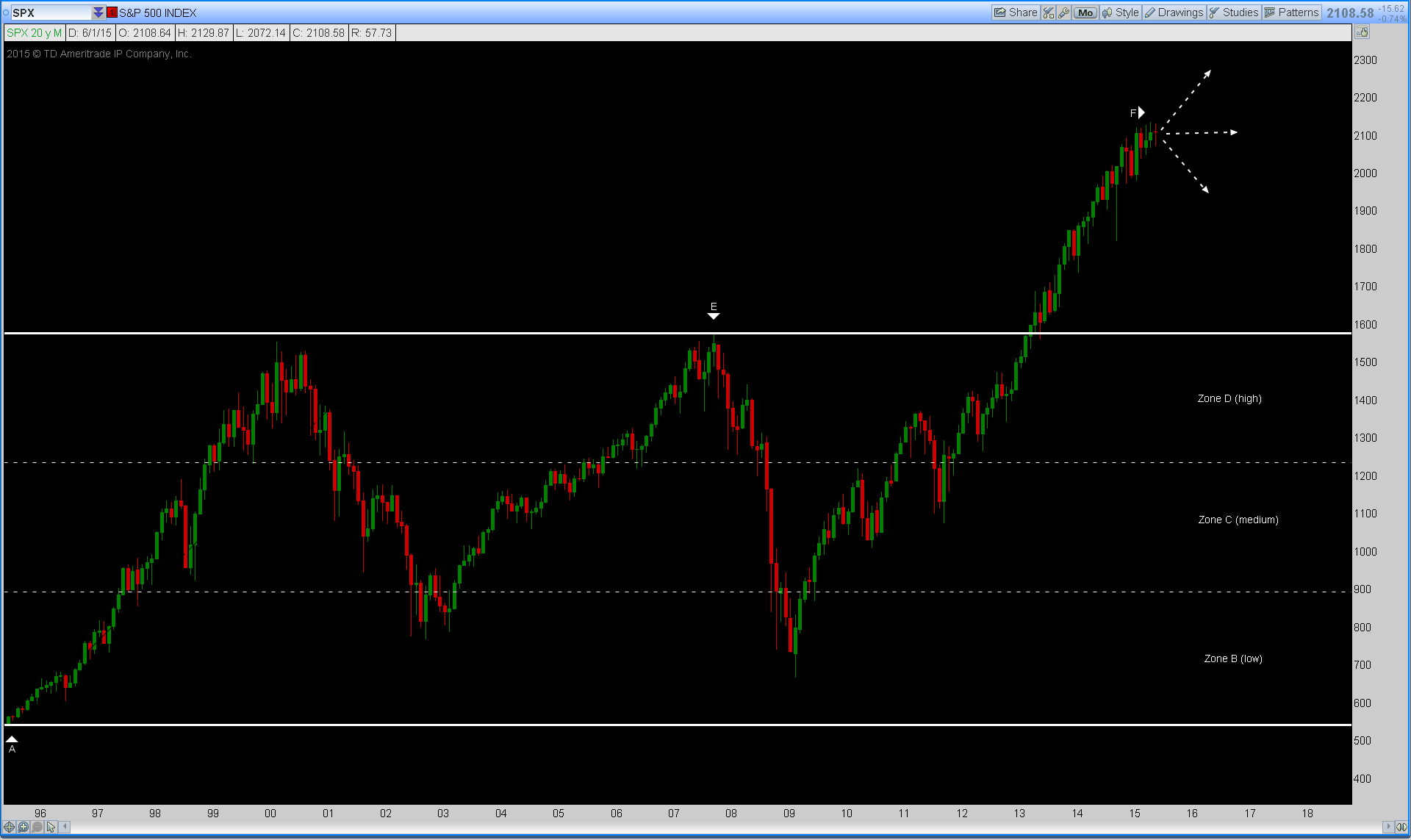
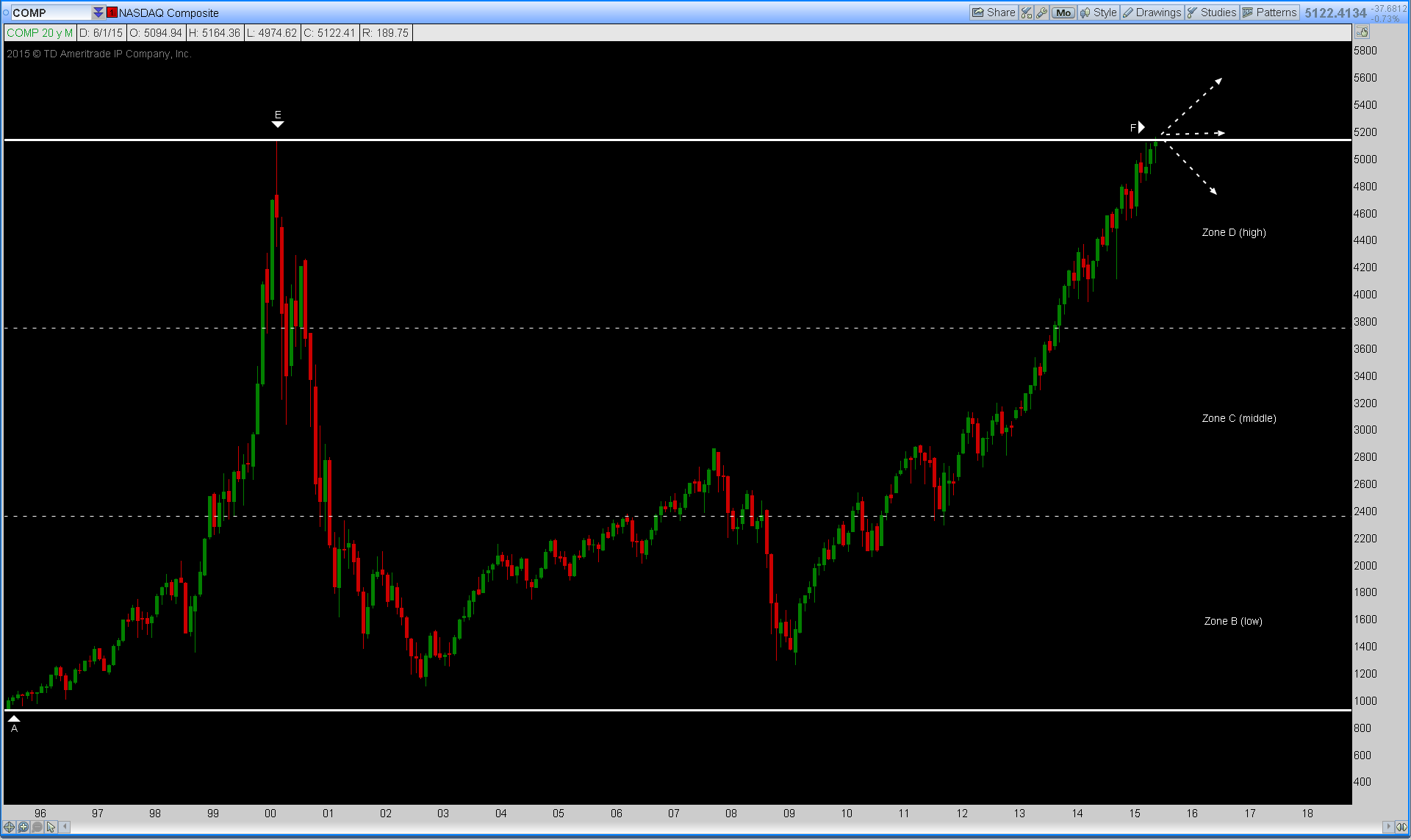
See below the 20 year stock charts (click to magnify) of S&P 500 and NASDAQ Composite – these 2 indexes basically capture the essence of the US boom-bust economic cycles.

SPX

COMP

In the both charts, I took the prior low (point A) & high (point E) and divided that area into 3 equal zones B/C/D – the lower third, middle third and upper third. Point F is where we are today – at all time highs. I know what you are thinking – from here on, are we going to go up (and for how long), go sideways or go lower? When is the market going to crash?

While those are valid questions, the point of this blog post is NOT about timing the stock market for profit. History tells us that this party is eventually going to end. When and how – I don’t know. Far too many super-smart people on the Wall Street don’t get that right so I am not even going to attempt that.

Instead, what I am presenting here is a broad framework that lets you align major life events with the boom-bust economic cycles. Given that we are currently at the highs of the economic cycle (i.e. zone D and beyond), you could think about the major life events that you have coming up in the next 2-5 years and position yourself accordingly. Some ideas:

  • If you are retiring in the next 2-5 years, a conservative plan would be to move your investments (e.g. stocks, 401k) into safer investments like CDs or bonds.
  • If your kids are going to enter college in the next 2-5 years and their college fund in invested in any investment that can be affected by the stock market, now might be the time to move that college fund into safer options.
  • If you have a startup and you are getting an attractive acquisition offer, depending on factors like cash flow, need for additional funding etc., its not a bad idea to consider an exit now.
  • If you live in an expensive real estate market and you plan to sell the house in the next 2-5 years (because you are retiring, downsizing, etc.), now is a good time to sell that house while the stock and real estate market is at record highs. Yes, by selling now you forego any future profits. The name of the game here is to conservatively protect your profits (given your 2-5 year time frame) and NOT about aggressively maximizing your profits trying to identify the absolute top.
  • If you are looking to buy a house, now is definitely not the best time – you could wait until the stock market returns to Zone B (or at least Zone C). Remember – once the market starts going down, it goes down very fast. The dot com excess in 2000 got cleaned up in 2.5 years and the subprime crisis excess in 2007 got cleaned up in about 1.5 years. If waiting for Zone B saves you 20%, that’s an easy $150k – $200k savings (or more) in the Bay Area housing market – that’s nothing to sneeze at!

The underlying principle here is very simple – aligning some of your big life decisions to lower third (zone B) and upper third (zone D) of the broad stock market increases the odds in your favor (but no guarantees)!

Also remember, this framework is NOT about maximizing the profits by riding the party bus to the absolute top – instead it’s about conservatively aligning the life events with broad economic cycles so that you are protected by increasing the odds in your favor!