Life is all about timing!
– Carl Lewis

In business or personal life, the timing of certain actions/decisions have long lasting impact – maybe even a lifelong impact.
A few examples:
- Kids graduating college in recession (as opposed to a flush economy) have to settle for 10%-15% reduction in earnings when they start their careers and they can take upto a decade to recover from that. For some kids, the impact may be life long – they may have started their careers in a less-then-desired industry (as a compromise in a down economy) and never ended up moving to the desired industry for which they studied. This topic has been well researched. Read more on this…
- Most of my friends bought their houses in Bay Area prior to 2008. When the housing market cratered with the sub-prime crisis in 2009 and the interest rates went really really low, many of us were lucky enough to refinance our houses at record low rates. However, some of my friends couldn’t do the same because their house values were “under-water” – our quirky mortgage financing system didn’t allow these people to refinance. Turns out that there were millions of people in that boat. All those people who held onto their houses and paid mortgages month after month – they were practically flushing cash down the proverbial toilet because they were paying mortgage at inflated interest rates. If these people had bought their houses a little earlier or a little later, they could have refinanced their mortgages!
- If you are an entrepreneur, here is one for you. Airbnb is a well known unicorn decacorn startup that upended the hotel industry by allowing people like you and me turn that extra bedroom into a cash cow. One of the main reasons for its success is attributed to the timing of when it was launched – Aug 2008, right around the subprime crisis. When the subprime recession hit the world, people needed that extra money and they eagerly jumped onto the Airbnb bandwagon jump-starting its success! Read more on this…
If timing is so important in life, how are we supposed to time such events – especially the big personal life events?
Even though you may not be able to time all events in life (e.g. timing of college graduation), I propose that some major life events can certainly be timed to your advantage. You can do that by using the broad stock market as tool for timing. While this is not easy, it is not impossible – you just need some fiscal discipline and a strong stomach! Here is the recipe…
See below the 20 year stock charts (click to magnify) of S&P 500 and NASDAQ Composite – these 2 indexes basically capture the essence of the US boom-bust economic cycles.
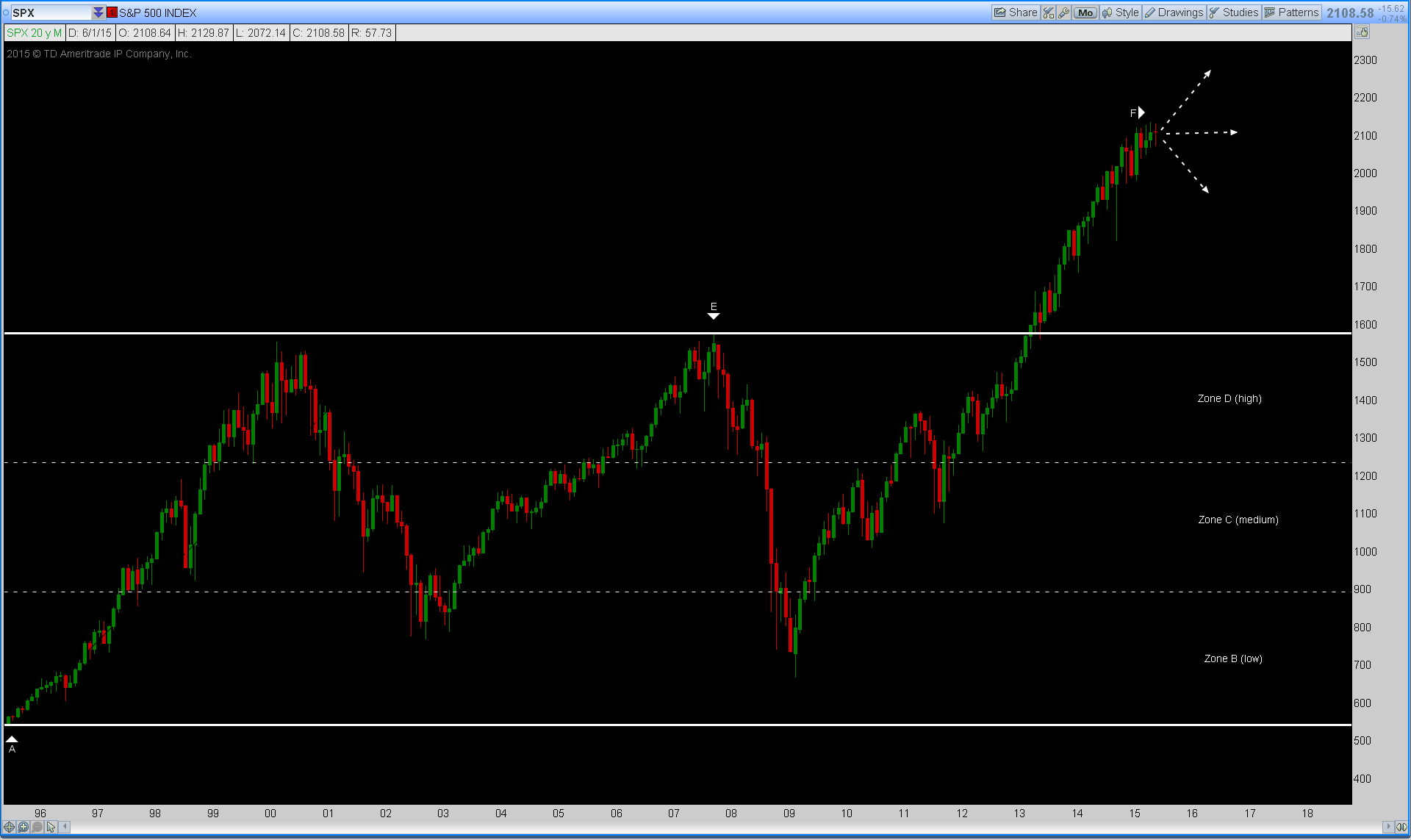
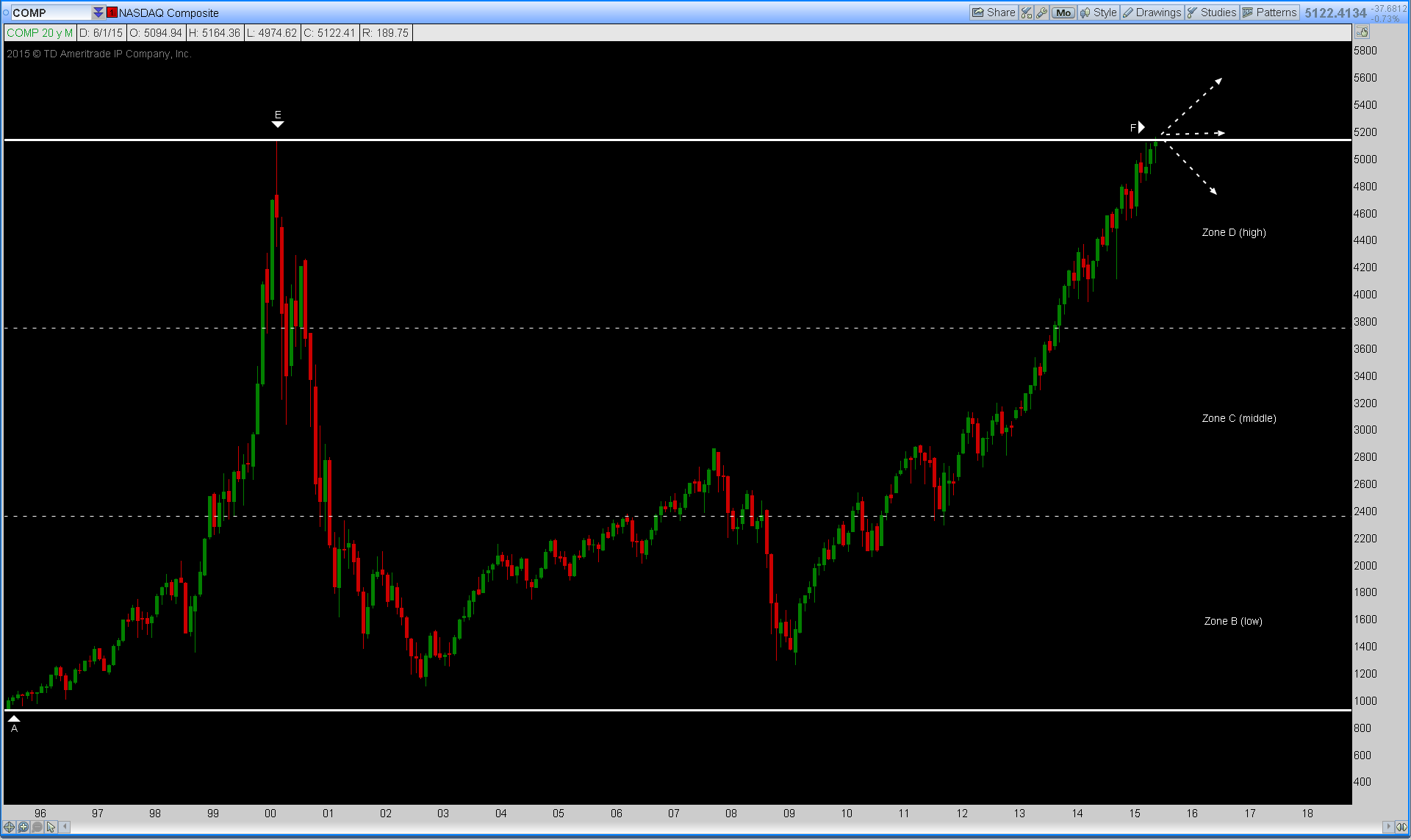
In the both charts, I took the prior low (point A) & high (point E) and divided that area into 3 equal zones B/C/D – the lower third, middle third and upper third. Point F is where we are today – at all time highs. I know what you are thinking – from here on, are we going to go up (and for how long), go sideways or go lower? When is the market going to crash?
While those are valid questions, the point of this blog post is NOT about timing the stock market for profit. History tells us that this party is eventually going to end. When and how – I don’t know. Far too many super-smart people on the Wall Street don’t get that right so I am not even going to attempt that.
Instead, what I am presenting here is a broad framework that lets you align major life events with the boom-bust economic cycles. Given that we are currently at the highs of the economic cycle (i.e. zone D and beyond), you could think about the major life events that you have coming up in the next 2-5 years and position yourself accordingly. Some ideas:
- If you are retiring in the next 2-5 years, a conservative plan would be to move your investments (e.g. stocks, 401k) into safer investments like CDs or bonds.
- If your kids are going to enter college in the next 2-5 years and their college fund in invested in any investment that can be affected by the stock market, now might be the time to move that college fund into safer options.
- If you have a startup and you are getting an attractive acquisition offer, depending on factors like cash flow, need for additional funding etc., its not a bad idea to consider an exit now.
- If you live in an expensive real estate market and you plan to sell the house in the next 2-5 years (because you are retiring, downsizing, etc.), now is a good time to sell that house while the stock and real estate market is at record highs. Yes, by selling now you forego any future profits. The name of the game here is to conservatively protect your profits (given your 2-5 year time frame) and NOT about aggressively maximizing your profits trying to identify the absolute top.
- If you are looking to buy a house, now is definitely not the best time – you could wait until the stock market returns to Zone B (or at least Zone C). Remember – once the market starts going down, it goes down very fast. The dot com excess in 2000 got cleaned up in 2.5 years and the subprime crisis excess in 2007 got cleaned up in about 1.5 years. If waiting for Zone B saves you 20%, that’s an easy $150k – $200k savings (or more) in the Bay Area housing market – that’s nothing to sneeze at!
The underlying principle here is very simple – aligning some of your big life decisions to lower third (zone B) and upper third (zone D) of the broad stock market increases the odds in your favor (but no guarantees)!
Also remember, this framework is NOT about maximizing the profits by riding the party bus to the absolute top – instead it’s about conservatively aligning the life events with broad economic cycles so that you are protected by increasing the odds in your favor!

 Technology, Strategy & Life